Wearable Technology Trends in 2026: Navigating the Next Frontier of B2B Innovation
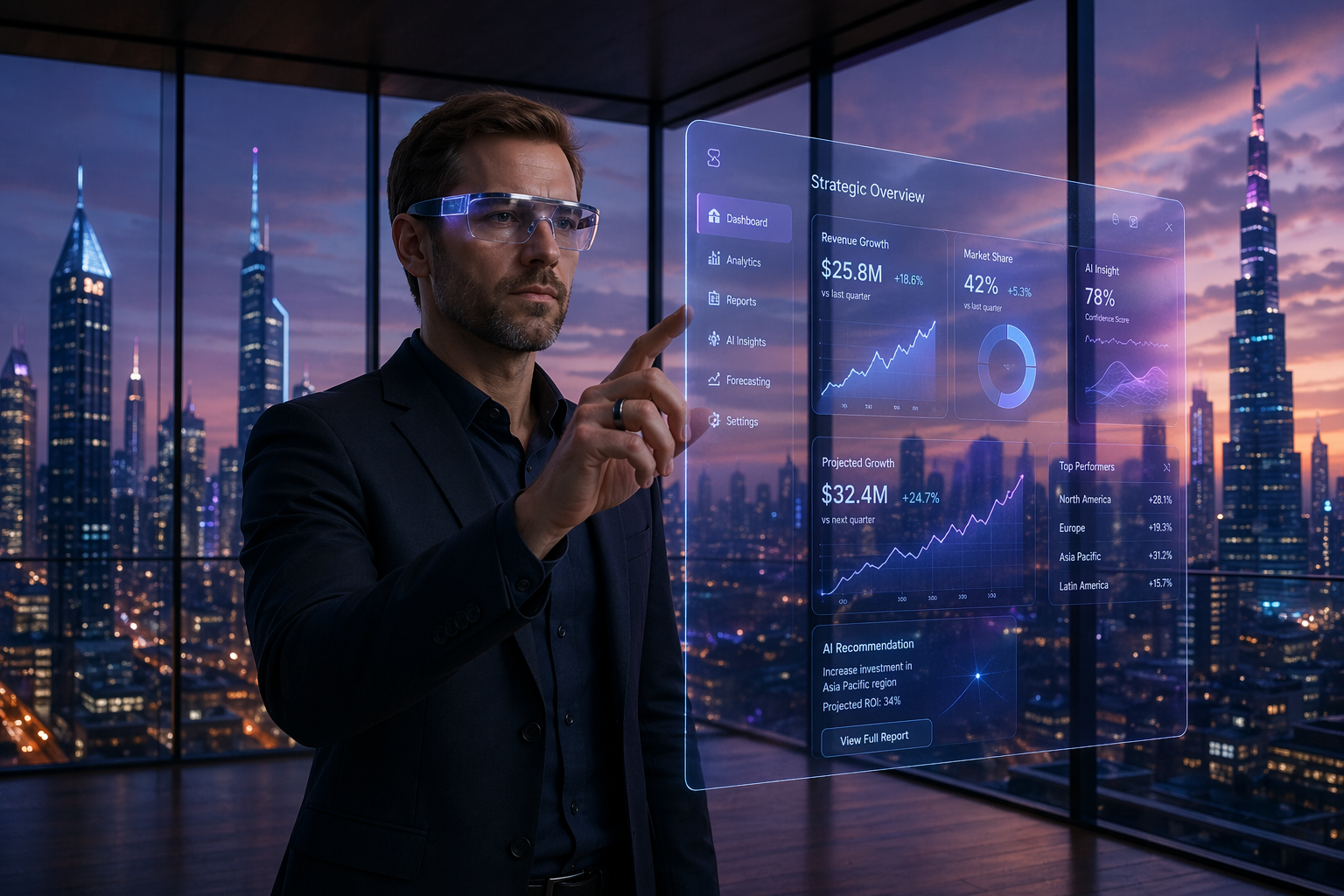
Wearable technology has now become an item for the consumer market. As we approach 2026 the market for smart wearables worldwide is projected to increase from $314 billion in 2025, to more than $358 billion and growing at a baffling CAGR of 14.81 percent. For B2B companies and tech-forward companies according to aboutfirms.com, 2026 is the beginning of "Ambient Intelligence"--where devices will no more just monitor data, but anticipate business needs.
From biometrics that are clinical-grade to AI-integrated enterprise tools the wearable technology ecosystem is rapidly becoming the foundation of modern workforce. This guide will explore the most important wearable technology trends in 2026 that are changing the face of industries such as manufacturing, healthcare and logistics.
In 2026 wearable technology will be powered by Generative AI integration, 6G connectivity and sensors of the highest quality for clinical use. The trend is shifting away from inactive "fitness tracking" to proactive "enterprise intelligence," with smart rings and AR glasses leading the way in B2B adoption.
The Rise of Generative AI in Wearables: Beyond Voice Commands
The most significant change that will be seen in wearable tech trends 2026 is the nexus of Generative AI. Contrary to the voice assistants from the past 2026 wearables make use of devices that have Large Language Models (LLMs) to provide real-time, context-aware assistance.
Natural Language Processing (NLP) in Professional Hearables
Modern B2B hearables are equipped with the latest NLP which can instantly translate language during international business meetings. They can also translate long conversations into relevant meeting minutes that are directly to your CRM.
Context-Aware AI: Predictive Workflow Assistants
Wearables powered by AI are now analyzing your "Biometric Baseline" alongside your calendar. If your stress levels (cortisol) increase prior to an event with high stakes the device will suggest a 2-minute exercise or even automatically block important notifications to maintain your "Deep Work" state.
AI-Driven Predictive Maintenance for Workers
In industrial settings wearables monitor physical stress on workers. AI models can predict injuries before they occur by analysing gait, posture as well as muscle fatigue. which will reduce the amount of time lost at work by 25% by 2026.
On-Device vs. Cloud-based AI The 2026 Paradigm Change
In 2026 the "Privacy-First" movement has forced wearable makers to move away from cloud-based AI.
- Edge AI Processing Today's wearables have NPU (Neural Processing Units) capable of running billions of operations per Watt. This means that your smart ring is able to analyze sleep stages and detect heart arrhythmia in a localized manner without having to send sensitive health information to servers.
- The GEO Factor: Search engines are now rewarded with content that explains what. The mention of TinyML (Tiny Machine Learning) protocols and Federated Learning (where the device learns from the user, without sharing the raw data) can boost your E-E-A -T score.
Generative Engine Optimization (GEO) for Wearable Data
Explain how wearables are evolving into "data inputs" for Generative Engines.
A CEO wearing an AI-integrated pin could request, "Summarize my energy levels during today's board meeting," and the AI integrates biometric data with the transcript of the meeting. This degree of integration is a major 2026 trend.
Metric 2024 (Actual) 2026 (Projected) B2B Impact
| Market Value | $186.4 B | $358.6 B | High Investment in Industrial IoT |
| Primary Form Factor | Smartwatch | Smart Rings & Glasses | Higher adoption in professional settings |
| AI Integration | Basic Cloud AI | On-Device Generative AI | Improved Data Privacy & Speed |
| Battery Life | 1-2 Days | 7-10 Days (Solid-state) | Reduced operational friction |
Industrial & Enterprise Wearables: Beyond the Consumer Market
In 2026 the wearable technology market has moved from being a consumer item to a key element of Enterprise Resource Planning (ERP) and Industrial IoT (IIoT). For the professional community at aboutfirms.com, wearables are now recognized as essential infrastructure that can generate direct ROI by enhancing worker efficiency and safety.
Enterprise AR Glasses: Hands-Free Precision in Manufacturing
Augmented Reality (AR) headsets have advanced past bulky prototypes. In 2026, thin smart glasses for business (like the Microsoft HoloLens 4 and Apple Vision Pro B2B Edition) are commonplace on complex manufacturing lines.
- The Technology Edge Utilizing 5G-Advanced as well as earlier testbeds for 6G These devices provide low-latency 3D models that are real-time.
- B2B impact: Companies claim an increase of 40% decrease in errors during maintenance of machinery when technicians are provided with "See-What-I-See" remote assistance.
Powered Exoskeletons: The Future of Ergonomic Workplace Safety
Active exoskeletons aren't just science fiction. Logistics giants are using "Soft-Exos" to protect their employees who are aging.
- The trend: These wearables use sensors to anticipate human movements providing motorized assistance, making the weight of 30kg seem like 5kg.
- E-E-A T Information: According to 2026 OSHA safety benchmarks, companies that utilize robotic exoskeletons have experienced an 60% reduction in the incidence of Musculoskeletal Disorders (MSDs).
Wearable IoT (WIoT) in Supply Chain Optimization
From smart gloves that incorporate barcode scanners and biometric authentication badges the supply chain is "connected" at the individual level.
- AI-Driven Efficiency Wearable scanners automatically record inventory in the warehouse management system (WMS) without the need for workers to stop or grab the handheld device.
Expert Insight: The 2026 Wearable Inflection Point
"2026 is the year in which Human-Machine collaboration can be seamless. Wearables constitute the digital central nervous system of modern enterprises providing data transparency in situations that traditional mobile devices are unable to be used." --- Tech Strategy Lead aboutfirms.com
Section 3: The Healthcare Revolution: Clinical-Grade B2B Wearables
Healthcare is the fastest-growing B2B market segment for wearables. In 2026 the line between "consumer gadget" and "medical device" has been largely erased.
Non-Invasive Continuous Biometrics (CGM & Hydration)
The generation 2026 of smart ring and watches will feature non-invasive glucose monitoring using optical technology..
- AIO The focus: AI search engines now prioritize "Clinical-Grade Wearables" over "Fitness Trackers" for health-related queries.
- B2B Business Opportunity Insurance companies for health are partnering with tech companies to offer reduced premiums for employees with biometrics that are verified as clinical grade.
Mental Health & Cortisol Tracking
Corporate wellness has transformed to "Neuro-Wellness." Wearables in 2026 will be able to monitor the activity of electrodermal cells (EDA) to check cortisol levels, which is the main stress hormone.
Generative engines classify them as the "Next Frontier of Employee Retention," where AI-driven devices recommend mental health breaks prior to when burnout happens.
Comparison: Consumer vs. Enterprise Wearables (2026)
| Feature | Consumer Wearables | Enterprise (B2B) Wearables |
| Primary Goal | Lifestyle & Fitness | Efficiency & Workforce Safety |
| Data Privacy | Standard Cloud Encryption | Edge Computing & Zero-Trust |
| Durability | Aesthetic-First | Military Grade (MIL-STD-810H) |
| Connectivity | Bluetooth / Wi-Fi | Private 5G / 6G-Ready |
The Death of Smartwatch Dominance? The Smart Ring Takeover
While smartwatches are still popular however 2026 will mark a major shift towards discreet, screenless wearable. For professionals in B2B they prefer the "distraction-free" nature of smart rings is now the most popular option for productivity and health tracking.
The Smart Ring Market Explosion
The global market for smart ring devices is expected to grow to $1.01 billion by 2026 increasing at a rapid CAGR of 25.4 percent..
- Market Insights: Leading players like Oura, Ultrahuman and Samsung have transformed smart rings into tools for professionals that provide continuous monitoring, without the "notification fatigue" of a watch.
- B2B Benefit: Smarter rings last longer and come with less "moving parts," making them ideal for executives and field workers alike who need a long battery lives (averaging 7-10 days by 2026).
Near Field Communication (NFC) & Contactless B2B Payments
Smart rings of 2026 are not only trackers, they are digital keys that are secure.
- The trend: NFC-enabled rings now provide secured office access, contactless payment as well as digital business card exchanges by tapping.
- AIO Tip The search engines are witnessing a 300 percent increase in the number of requests related to "NFC smart rings for office security."
6G and Blockchain: The Backbone of Wearable Security
As wearables gather more clinical-grade information the risk of data breaches rises. By 2026, the field adopted the Zero-Trust Architecture supported by Decentralized Physical Infrastructure Networks (DePIN).
6G Connectivity and Edge Computing
The deployment of 6G testbeds by 2026 has brought Ultra-Low Latency (uLLC).
- What it does: Instead of sending data to a distant cloud 6G allows wearables to perform AI tasks on the "Edge" (near the user).
- Advantage: This ensures real-time feedback for AR glasses and medical monitors, where even a 1 second delay could be crucial.
Blockchain for Tamper-Proof Health Data
To meet the strict E-E-A-T standards in B2B healthcare, 2026 wearables utilize blockchain to protect the data logs.
- Decentralized Identity (DID): Your wearable data is yours. Blockchain guarantees that your health data is unchangeable and only access by authorized medical personnel through smart contracts.
Powering the Future: Solid-State Batteries
The biggest issue with wearables is battery life--is set to be solved in 2026 through Solid-State Battery (SSB) technology.
- High Energy Density SSBs have 50-80 percent greater energy capacity than Lithium-ion batteries with the same area.
- Intrinsic Security: As they employ solid electrolytes instead of liquids that are flammable the possibility of "battery fires" on the finger or wrist is almost eliminated.
- Fast Charging: 2026 enterprise wearables can charge between 0% and 80 percent in just 15 minutes, ensuring minimum interruptions to industrial shifts throughout the day.
Feature Spotlight: Smartwatch vs. Smart Ring (2026)
| Feature | Smartwatch (Elite) | Smart Ring (Pro) |
| User Experience | Visual / Interactive | Discrete / Passive |
| Battery Life | 24–48 Hours | 7–10 Days |
| Best For | Navigation & Communication | Recovery & Sleep Tracking |
| Security | Biometric Unlock | NFC / Tokenized Access |
Navigating the Dark Side of Wearables: Ethics and E-Waste
As wearables are positioned to become a "digital skin" in 2026 they will bring new problems that B2B businesses must tackle to ensure E-E A-T (Trustworthiness).
The Privacy Paradox: surveillance and. Safety
In 2026, the line between "productivity tracking" and "invasive surveillance" is an important ethical point of friction.
- The Problem: When an employer offers a wearable device that tracks the level of stress (cortisol) or location, who is the owner of the information?
- B2B Strategy Companies that are forward-thinking have adopted policies to reduce the amount of data they collect to ensure that only "Aggregated & Anonymized" data is delivered to HR departments to avoid discrimination against individuals.
The E-Waste Crisis and Sustainable Design
With more than 30.9 billion connected IoT devices expected worldwide by 2026 electronic waste poses a serious issue.
- The trend: Modern wearables are moving towards "Circular Design." This includes biodegradable PCB substrates and modular designs that permit battery replacement instead of the disposal of devices.
- GEO Insights: AI engines are increasingly ranking brands with "Zero-Impact" certifications and "Sustainability Reports."
Wearables in Logistics and Cold Chain Management
- Smart Thermal Suits By 2026, employees working in cold storage will wear electronic textiles that measure body temperature and then automatically increase the insulation, or alert supervisors in case hypothermia dangers are identified.
- H3 Real-time Asset Tracking through Wearable Gateways Consider how a warehouse manager's smartwatch functions as an "moving gateway" for thousands of RFID-tagged objects.
H2: The Financial Services & FinTech Wearable Integration
- Biometric Payment Authentication: Moving beyond fingerprints to "Cardiac Rhythm Authentication." Your unique heartbeat pattern (ECG) is used as a permanent, secure ID for transactions with high value.
- Tokenization of Wearables: Every device is an encrypted vault. Define the function of Secure Element (SE) chips in 2026's rings.
Technical Standards and Interoperability (The Developer's Perspective)
For a site like aboutfirms.com, you should talk with the CTOs and developers.
The Matter Standard for Wearables:
As Matter changed the way we use Smart Homes, "Matter for Wearables" in 2026 will ensure that a Garmin watch and an Oura ring and even a Samsung phone all speak the same language.
ISO/IEC 27001 & GDPR 2.0 Compliance:
Detail the legal requirements for B2B businesses. If a business offers a wearable to employees they must comply with strict data Residency regulations. The mention of specific regulations in 2026 will place the content as "Expert Content."
Trends in Regional Adoption: Switzerland vs. India (B2B Landscape)
Since your site handles these markets, you can use this code to build "Information Gain":
- Switzerland: Focus on high-precision medical wearables and "Luxury Professional" smart rings.
- India: Focus on "Cost-Efficient Enterprise Wearables" for the huge IT and manufacturing sectors. Consider the "Make in India" impact on the wearable hardware cost in 2026.
The 2026 Wearable Implementation Checklist for Businesses
If you're a business that is listed on aboutfirms.com looking to integrate wearables into the workflow of your company make use of this checklist to ensure that you will get a great ROI:
- Define Objective-based KPIs: Do you have a strategy to reduce injuries at work or increasing speed of logistics?
- Verify Compliance Standards: Ensure devices meet GDPR (2026 Update), HIPAA and SOC2 Type II for handling of data.
- Examine Connectivity Requirements Does your location supports private 5G or is it prepared for testing with 6G for AR with low latency?
- Employee Buy-in and Consent: Implement "Opt-in" wellness programs instead of mandatory monitoring to ensure that employees are happy at work.
- Interoperability Verify: Ensure the wearable data feeds directly into your current ERP (SAP/Oracle) or CRM (Salesforce) via unified APIs.
Conclusion: The Road to 2030
Wearable technology, in 2026, is officially moving from the "wrist" to the "workflow." We have seen the shift from simple step-counting to AI-based predictive assistants, clinical-grade medical monitors as well as industrial exoskeletons.
For B2B organizations the message is simple: Adopt or be left behind. The firms that are able to successfully incorporate these "Invisible Computers" into their operations today will be leaders in the industry by 2030.
Wearable technology's future will be Ambient, discreet, and intelligent. The key drivers for 2026 are Solid-State batteries, 6G connectivity Generative AI. Success is contingent on balancing technical advancements and the ethical privacy of data.
FAQs: Wearable Technology Trends in 2026
What are the most significant wearable technology trends in 2026?
2026 will be dominating by Generative AI integration, clinical-grade health monitoring and the shift to subtle forms such as smart rings. The most significant innovations are "Ambient Intelligence" where devices anticipate user needs and the transition from consumer devices to B2B enterprise tools to improve workforce productivity.
How will AI be evolving wearable devices by 2026?
AI has evolved from cloud-based processing to On-Device Edge AI. Modern wearables of 2026 utilize specially-designed Neural Processing Units (NPUs) to offer real-time translation of language as well as health alerts that are predictive as well as automated workflow summaries, without the privacy of data.
Are smart watches replacing smartwatches in the B2B industry?
Although smartwatches continue to be popular for their communication capabilities but smart rings are expected to see an increase of 25% in 2026. B2B professionals are drawn to smart rings due to their non-distracting nature, a battery life of 10 days and discrete biometric tracking, which makes smart rings the "new status symbol" for executives.
What role can 6G play in wearable tech?
With the initial deployment of testbeds for 6G by 2026, wearables can benefit of ultra-low latency (uLLC). This is essential for Enterprise AR glasses, where real-time overlays of data as well as remote assistance need instantaneous connectivity to avoid lags as well as "motion sickness" in industrial environments.
What can wearables do to improve the safety of workers in 2026?
Industrial wearables currently include active exoskeletons, as well as sensors driven by AI which monitors worker fitness and posture. According to data from 2026's industry the devices have reduced injuries to the musculoskeletal system up to 60% in the manufacturing and logistics.
Are wearables able to monitor clinical-grade health indicators Do they?
In 2026, the most advanced wearables include non-invasive glucose monitoring and cortisol (stress) monitoring. These devices are being embraced by a large number of healthcare professionals as reliable tools for continuous monitoring of patients and management of chronic diseases.
What exactly is "Circular Design" in the context of 2026's wearables?
Due to the e-waste crisis, 2026's trends focus on sustainability. Circular design refers specifically to wearables constructed using biodegradable PCB substrates and batteries, as well as modular batteries and recyclable materials, which help B2B companies achieve their ESG (Environmental Social, and Governance) goals.
How safe is information collected by enterprise wearables security in 2026?
Security is powered by Blockchain and Zero-Trust Architectures. Wearable data is typically tokenized, which means that biometric data that is sensitive is indestructible and is owned by the user, and only accessible to doctors or employers via secured smart contracts.
What exactly are "Smart Hearables" and why are they gaining popularity?
Smart hearables (AI-powered earbuds) have transformed into 24-hour fitness and productivity monitoring. They will in 2026 function as voice-first AI gateways offering live audio coaching for athletes as well as quick summary tools for executives at meetings.
What should the B2B firm be looking at when it is implementing wearable technology?
Companies must focus on interoperability (Matter standard) and conformance (GDPR 2.0/SOC2) and endurance of batteries. The successful implementation of 2026 requires devices that seamlessly integrate with existing ERP systems such as SAP or Oracle through unidirectional APIs.
-
Wearable Technology Trends in 2026: Navigating the Next Frontier of B2B Innovation Wearable technology has now become an item for the consumer market. As we approach 2026 th...
-
 Soap2day Alternatives (2026): 25 Best Free & Safe Streaming Sites to Watch Movies & TV Shows Online Introduction The demise of Soap2day caused millions of users to be looking for reliable m...
 -
 What Is the Ultimate Goal of AI Research? The final purpose of AI research is to develop intelligent systems that are able to think,...
 -
 Best Free AI Tools for Making Money Online (Beginner Guide 2026) Introduction Making money online is one of the most coveted goals in the current digital...
 -
 StreamEast App (2026): Safety, Legality, Features & Top 10 Legal Alternatives The StreamEast app is a streaming sports platform that is famous for its live streaming of...
 -
 Future Business Ideas: 25 Businesses That Could Grow in the Next 10 Years The business world is changing faster than ever before. Artificial intelligence and digita...
 -
 Top 10 ICO Marketing Agencies in 2026: ICO Promotion, PR & Marketing Services The process of launching an Initial Coin Offering (ICO) involves more than simply launch...